Monday, October 15, 2007

A journey through John - 11:5-6

"Now Jesus loved Martha and her sister and Lazarus. So when he heard that he was ill, he stayed two days longer in the place where he was."

Jesus is just maddening sometimes, isn't He? What is He waiting around for? What on earth is He doing where He is while His friend is dying?

Why does Jesus stay two days longer in the place where He was? Precisely because He loved Lazarus and his sisters, John insists. That little So has got to be one of the most perplexing, frustrating conjunctions in all of Scripture. Jesus took His sweet time going to see Lazarus because he loved him! Jesus loved Lazarus; therefore He couldn't be bothered to lift a finger to help him! It doesn't make any sense!

And so, once Jesus actually decides to get going and finally arrives at the home of Mary and Martha, Lazarus is already dead. His sisters betray some of the same frustration that we feel at His tardiness: "Lord, if you had been here, my brother would not have died," they both tell him (11:21, 32).

But Jesus has a plan in all this. As He said upon hearing the news of Lazarus' sickness, "This illness . . . is for the glory of God, so that the Son of God may be glorified by means of it" (11:4). Jesus allows His friend Lazarus to die so that, in the presence of all the mourners, He can demonstrate His power and divinity by raising Lazarus from death to life, so that they might all have faith in Him. Before Jesus commands Lazarus to come out of his tomb, He prays, "Father, I thank thee that thou hast heard me. I knew that thou hearest me always, but I have said this on account of the people standing by, that they may believe that thou didst send me" (11:42).

Indeed, it is because Jesus loves Lazarus and his sisters that He does wait to answer Mary's and Martha's plea to help their brother. He loves them so much that He wishes to reveal to them His power over death, so that they might believe that He is the Son of God and lay claim to the new and everlasting life He offers to everyone: "I am the resurrection and the life; he who believes in me, though he die, yet shall he live, and whoever lives and believes in me shall never die" (11:25-26).

Pope Benedict XVI on sacred music

There's a nice little article on zenit.org about Pope Benedict XVI's recent speech at the Pontifical Institute of Sacred Music about the importance of sacred music. An excerpt:

"'How rich is biblical and patristic tradition in highlighting the efficacy of song and sacred music in moving hearts and lifting toward, we could say, the very intimacy of the life of God,' he said.

"Benedict XVI recalled that Pope John Paul II said that 'today, as always, three characteristics distinguish sacred music: its "sanctity," its "true art," and its "universality," in other words the fact that it can be presented to any people or assembly.'"

A lot of people might think the Pontiff is a little out of touch if he believes that sacred music could possibly have a universal appeal in this day and age, but I defy anyone to quietly listen to Palestrina's Missa Papae Marcelli, for example, and not be elevated and exhilarated. (Even if it isn't that great of a recording.)

St. Teresa of Avila and prayer

October 15 is the memorial of St. Teresa of Avila, a 16th century mystic and reformer who was recognized in 1970 as a Doctor of the Church and who is commemorated in Bernini's famous The Ecstasy of St. Teresa (left). I've just been trying to learn a little bit about her life today, and I came across a passage in the Catechism of the Catholic Church that contains a very nice quote from her:

"What is contemplative prayer? St. Teresa answers: 'Contemplative prayer [oracion mental] in my opinion is nothing else than a close sharing between friends; it means taking time frequently to be alone with him who we know loves us.'"

Sounds good to me.

Prayer of St. Ephrem

I just think this is such a beautiful prayer. It is attributed to St. Ephrem the Syrian, a Doctor of the Church who wrote many many hymns during the 4th century. I need to pray this prayer every day. Here it is:

O Lord and Master of my life, take from me the spirit of laziness, meddling, ambition, and vain talk. But give me a spirit of prudence, humility, patience, and love. Yes, Lord and King, grant me to see my own sins and faults and not judge my brother. For You are blessed forever and ever. Amen.

Sunday, October 14, 2007

A journey through John - 10:11-15

"I am the good shepherd. The good shepherd lays down his life for the sheep. He who is a hireling and not a shepherd, whose own the sheep are not, sees the wolf coming and leaves the sheep and flees; and the wolf snatches them and scatters them. He flees because he is a hireling and cares nothing for the sheep. I am the good shepherd; I know my own and my own know me, as the Father knows me and I know the Father; and I lay down my life for the sheep."

Jesus here prophesies that He will die for the sake of all humanity, His flock. Now, I know that I don't have nearly enough faith or understanding to come close to appreciating the full weight of this, but I just have to keep reminding myself that when we talk about Jesus, we're talking about God, the Creator of the universe, and for some reason He loves us lowly creatures enough to die for us. And not just die, but willingly subject Himself to the most shameful execution the Roman world could come up with.

This is simply remarkable to me. I think many Christians are so used to hearing that God loves us that we start to take it for granted. "Of course God loves me -- why wouldn't He?"

But why should He? He didn't even need to create us! He made us out of nothing! We are infinitely below Him in every respect. And yet He loves us. Enough to die a painful, humiliating death for us.

All I can say is, thank God that God is not an aloof, uninterested, uninvolved god. Thank God that God is not the god of the deists. Thank God that God is a compassionate, Self-sacrificing Shepherd Who loves us lowly sheep as His own and has not left us to be snatched up by the wolves of this world.

Saturday, October 13, 2007

What does "Christianity" mean?

John Shelby Spong is a 76-year-old former Episcopal Bishop of Newark who writes a lot of books with subtitles like A Bishop Rethinks the Meaning of Scripture and A Bishop Rethinks the Birth of Jesus. I stumbled across a brief essay of his today entitled "A Call for a New Reformation," which I read with great interest. It concluded with the following passage:

"Martin Luther ignited the Reformation of the 16th century by nailing to the door of the church in Wittenberg in 1517 the 95 Theses that he wished to debate. I will publish this challenge to Christianity in The Voice. I will post my theses on the Internet and send copies with invitations to debate them to the recognized Christian leaders of the world. My theses are far smaller in number than were those of Martin Luther, but they are far more threatening theologically. The issues to which I now call the Christians of the world to debate are these:

"1. Theism, as a way of defining God, is dead. So most theological God-talk is today meaningless. A new way to speak of God must be found.
2. Since God can no longer be conceived in theistic terms, it becomes nonsensical to seek to understand Jesus as the incarnation of the theistic deity. So the Christology of the ages is bankrupt.
3. The biblical story of the perfect and finished creation from which human beings fell into sin is pre-Darwinian mythology and post-Darwinian nonsense.
4. The virgin birth, understood as literal biology, makes Christ's divinity, as traditionally understood, impossible.
5. The miracle stories of the New Testament can no longer be interpreted in a post-Newtonian world as supernatural events performed by an incarnate deity.
6. The view of the cross as the sacrifice for the sins of the world is a barbarian idea based on primitive concepts of God and must be dismissed.
7. Resurrection is an action of God. Jesus was raised into the meaning of God. It therefore cannot be a physical resuscitation occurring inside human history.
8. The story of the Ascension assumed a three-tiered universe and is therefore not capable of being translated into the concepts of a post-Copernican space age.
9. There is no external, objective, revealed standard writ in scripture or on tablets of stone that will govern our ethical behavior for all time.
10. Prayer cannot be a request made to a theistic deity to act in human history in a particular way.
11. The hope for life after death must be separated forever from the behavior control mentality of reward and punishment. The Church must abandon, therefore, its reliance on guilt as a motivator of behavior.
12. All human beings bear God's image and must be respected for what each person is. Therefore, no external description of one's being, whether based on race, ethnicity, gender or sexual orientation, can properly be used as the basis for either rejection or discrimination.

"So I set these theses today before the Christian world and I stand ready to debate each of them as we prepare to enter the third millennium."

I don't think it's going too far to say that, in these twelve theses, Spong has flatly rejected (or attempted to reject) a few of the more central tenets of the Christian faith as it has been almost universally understood for nearly 2,000 years. Now, this would be easily understandable if Spong's goal were to destroy Christianity, but he actually asserts that his proposed "Reformation" is the "only . . . thing [that] will save this venerable faith tradition." The way he sees it, this "Reformation will be about the very life and death of Christianity," and he claims to be rooting for life.

Based on what little I know of John Shelby Spong, he seems like an intelligent, amiable, and generally good man, but I can't help feeling that his whole project is a bit disingenuous. While Spong claims to want to save "Christianity," he exhibits nothing but disdain for the traditional faith, and I cannot fathom why (or how, for that matter) he ever became a bishop, or why he insists on calling his non-religious, humanistic set of beliefs "Christianity." I honestly don't understand.

Maybe for the publicity?

Friday, October 12, 2007

A journey through John - 9:6-7

"As he said this, he spat on the ground and made clay of the spittle and anointed the man's eyes with the clay, saying to him, 'Go, wash in the poor of Siloam' (which means Sent). So he went and washed and came back seeing."

What I find most remarkable about this passage is how Jesus uses such mundane materials -- water, dirt, and spit -- to effect a miracle and enable a man born blind to see. He certainly doesn't have to -- He is God, He can do whatever He wants, He can perform miracles merely by commanding them. But in this case, for whatever reason, Jesus chooses to work through the humble medium of matter.

I find it helpful to remember this sometimes when it seems hard to believe that God would actually convey grace through the everyday elements -- water, oil, bread, wine -- of the sacraments of the Church.

I think there's an almost Gnostic tendency these days to feel that all things spiritual must somehow be kept separate from the lowly material realm. But to hold this belief consistently would be to resist the truth not only of certain of Jesus' miracles, but also of the mystery at the very center of the Christian faith: that God effected our salvation by becoming flesh and dying on a cross.

Thursday, October 11, 2007

G. K. Chesterton's blind faith

What little I've read of G. K. Chesterton's writings, I've always loved. Here's the opening line of his autobiography:

"Bowing down in blind credulity, as is my custom, before mere authority and the tradition of the elders, superstitiously swallowing a story I could not test at the time by experiment or private judgment, I am firmly of the opinion that I was born on the 29th of May, 1873, on Campden Hill, Kensington; and baptised according to the formularies of the Church of England in the little church of St. George opposite the large Waterworks Tower that dominated that ridge."

Think about it.

Wednesday, October 10, 2007

St. Hilary of Poitiers

I though zenit.org provided a very nice summary of Pope Benedict XVI's teaching about St. Hilary of Poitiers, a Church Father I had never heard of before, but who sounds like an incredible guy:

"Benedict XVI lauded what he called a gift of St. Hilary of Poitiers: the ability to combine meekness in interpersonal relationships and firm compliance to sound doctrine.

"The Pope said this today at the general audience in St. Peter's Square, in which he continued his reflection on the Fathers of the Church, turning his attention to the fourth-century bishop.

"Noting that St. Hilary confronted the Arian heresy and suffered exile for his adherence to the true faith, the Holy Father said the saint was 'always firm in his opposition to radical Arians.'

"But, the Pontiff affirmed, Hilary 'showed a conciliatory spirit with those who accepted that the Son was similar to the Father in essence, naturally trying to lead them toward the fullness of faith, which says that there is not only a similarity, but a true equality of the Father and the Son in their divinity.'

"The Pontiff called Hilary's desire to forge unity a characteristic of the saint's life: 'His conciliatory spirit tries to understand those who still have not yet arrived to the fullness of the truth and helps them, with great theological intelligence, to reach the fullness of faith in the true divinity of the Lord Jesus Christ.

"'This was precisely his gift: uniting strength of faith and meekness in interpersonal relationships.'"

Tuesday, October 9, 2007

A journey through John - 8:31-33

"Jesus then said to the Jews who had believed in him, 'If you continue in my word, you are truly my disciples, and you will know the truth, and the truth will make you free.' They answered him, 'We are descendants of Abraham, and have never been in bondage to any one. How is it that you say, "You will be made free"?'

"Jesus answered them, 'Truly, truly, I say to you, every one who commits sin is a slave of sin.'"

There is so much that could be gleaned from these few verses, but right now I'm going to focus on the response that the Jews give to Jesus' offer of freedom: "We are descendants of Abraham, and have never been in bondage to any one. How is it that you say, 'You will be made free'?"

Wrapped up in those two little sentences are so many unfortunate things: misunderstanding, defensiveness, pride, denial, false security.

The Jews do not even know what kind of freedom Jesus is talking about, yet they immediately jump to justify themselves by their earthly lineage. They believe that, as members of the chosen people of God, they are all set, so to speak, and need no help from this uppity Jesus guy.

The problem is that these Jews have become so secure and complacent in their status as the chosen people of God that their hearts have grown cold, so much so that they react hostilely when God Himself speaks the truth to them in person.

How often is this true of us as well? How often are we too secure in our own earthly positions? How often do we cut Jesus off, telling him, "Hey, I'm a pretty good guy. Who are you to tell me how to live"? In so many words, probably not very often. But in our attitudes and actions? Far, far too often, at least for me. I don't like to be reminded that I'm a slave to sin. I don't want to be told that I'm not living up to all I was meant to be.

Jesus doesn't just want to call us out on all our shortcomings, though. He came not to criticize us, ridicule us, belittle us, condemn us, but to save us, to provide us with a way out of our self-destructive tendencies. And that way is Himself. As He said: "If you continue in my word, you are truly my disciples, and you will know the truth, and the truth will make you free." Jesus is "the way, and the truth, and the life" (John 14:6). We must understand that. We must stop fighting Him. We must open ourselves to the wonderful freedom He never ceases to offer us.

Monday, October 8, 2007

A journey through John - 7:11-13

"The Jews were looking for him at the feast, and saying, 'Where is he?' And there was much muttering around him among the people. While some said, 'He is a good man,' others said, 'No, he is leading the people astray.' Yet for fear of the Jews no one spoke openly of him."

The subject of all this hushed discussion and debate is Jesus, of course. He's quite a captivating character. Everyone has an opinion about him. "Yet for fear of the Jews no one spoke openly about him." The people don't want to run afoul of the authorities by being overheard talking about Jesus, Who isn't exactly in the good graces of the earthly powers that be. So they whisper a little bit with those close by and say no more.

I think most of us today are in much the same position as the people at that feast almost 2,000 years ago. Most of us have pretty strong personal beliefs one way or another about Jesus, or about Christianity, or about God or religion more generally. And while I'd guess that most people aren't held back by fear of the Jewish authorities these days, there is something that keeps the great majority of us from speaking openly about our beliefs.

I think that nowadays the fear that keeps us clammed up about our religious beliefs is the fear of offending people, or of being labeled as "narrow-minded" or "judgmental." Our silence does no one any real good, though. It only prevents the possibility of real understanding between people of differing beliefs.

We need to start talking, not offensively, not narrow-mindedly, not judgmentally, but openly and honestly.

Sunday, October 7, 2007

Theology and Sanity

So, I've been reading a book called Theology and Sanity by Frank Sheed. I've just finished the first of three sections, and I must say that it has been a great book so far. It's written with great clarity and wit, and it covers some rather important topics -- the three major sections are entitled "God," "Creation," and "Oneself." I would recommend this book to anyone interested in understanding the basics of Christian theology. It's neither overly technical nor dumbed-down in the least. I was initially attracted to the book because Karl Keating, the founder and president of Catholic Answers, claimed that it contained "the clearest explanation of the Trinity ever put on paper," and it did live up to my expectations in that respect. Here's how the book opens:

"My concern in this book is not with the Will but with the Intellect, not with sanctity but with sanity. The difference is too often overlooked in the practice of religion. The soul has two faculties and they should be clearly distinguished. There is the will: its work is to love -- and so to choose, to decide, to act. There is the intellect: its work is to know, to understand to see: to see what? to see what's there.

"I have said that my concern is with the intellect rather than with the will: this not because the intellect matters more in religion than the will, but because it does matter and tends to be neglected, and the neglect is bad. I realize that salvation depends directly upon the will. We are saved or damned according to what we love. If we love God, we shall ultimately get God: we shall be saved. If we love self in preference to God then we shall get self apart from God: we shall be damned. But though in our relation to God the intellect does not matter as much as the will (and indeed depends for its health upon the will), it does matter, and as I have said, it is too much neglected -- to the great misfortune of the will, for we can never attain a maximum love of God with only a minimum knowledge of God."

The intellect matters, Sheed maintains, because "every new thing known about God is a new reason for loving Him." I couldn't agree more.

Saturday, October 6, 2007

Pope Benedict XVI on natural law and democracy

There's a good article on zenit.org about Pope Benedict XVI's recent speech to members of the International Theological Commission. You know, the more I hear from the Holy Father, the more I like him. He is completely unafraid to speak the truth to a world in which so many people no longer believe in such a thing. Here's an excerpt from the article:

"Benedict XVI affirmed that natural law is actually a guarantee of freedom.

"He explained: 'When fundamental essentials are at stake: human dignity, human life, the institution of the family and the equity of the social order -- in other words the fundamental rights of man -- no law made by men and women can subvert the norm written by the Creator in man's heart without society itself being dramatically struck ... at its very core.

"'Thus natural law is a true guarantee for everyone to live freely and with respect for their dignity, protected from all ideological manipulation and from all arbitrary abuses of the powerful.

"'No one can disregard this appeal. If by reason of a tragic clouding of the collective conscience, skepticism and ethical relativism managed to annul the fundamental principles of natural moral law, the very democratic order itself would be profoundly undermined at its foundations.'"

Friday, October 5, 2007

A journey through John - 6:51-52

"'I am the living bread which came down from heaven; if any one eats of this bread, he will live for ever; and the bread which I shall give for the life of the world is my flesh.'

"The Jews then disputed among themselves, saying, 'How can this man give us his flesh to eat?'"

It's not uncommon, in the Gospels, for Jesus to be misunderstood by those who hear Him. Especially when Jesus starts talking about food, His hearers repeatedly make the mistake of taking Him literally when He is really speaking metaphorically.

Take, for example, this exchange recorded in the Synoptic Gospels between Jesus and His disciples: "Jesus said to them, 'Take heed and beware the leaven of the Pharisees and Sadducees.' And they discussed it among themselves, saying, 'We brought no bread'" (Matthew 16:6-7). Jesus responds, "O men of little faith, why do you discuss among yourselves the fact that you have no bread?" (16:8) and continues, "How is it that you fail to perceive that I did not speak about bread?" (16:11). Matthew narrates the disciples' delayed epiphany: "Then they understood that he did not tell them to beware of the leaven of bread, but of the teaching of the Pharisees and Sadducees" (16:12).

A similar episode occurs in the Gospel of John just after Jesus has spoken with the Samaritan woman: "Meanwhile the disciples besought him, saying, 'Rabbi, eat.' But he said to them, 'I have food to eat of which you do not know.' So the disciples said to one another, 'Has any one brought him food?' Jesus said to them, 'My food is to do the will of him who sent me, and to accomplish his work'" (John 4:31-34).

The pattern in both these episodes is the same: 1) Jesus speaks metaphorically about food; 2) His hearers mistakenly interpret His words literally; 3) Jesus explains that He was not speaking literally, but rather metaphorically.

One would expect this pattern to hold true in the above passage from John 6, in which Jesus speaks of eating the living bread which is His flesh, and His hearers clearly understand Him to be speaking literally ("How can this man give us his flesh to eat?"). So how does Jesus explain to them that He was not actually speaking literally? Let's see:

"So Jesus said to them, 'Truly, truly I say to you, unless you eat the flesh of the Son of man and drink his blood, you have no life in you; he who eats my flesh and drinks my blood has eternal life, and I will raise him up on the last day. For my flesh is food indeed, and my blood is drink indeed. He who eats my flesh and drinks my blood abides in me, and I in him.'" (John 6:53-56)

Why does Jesus neglect to clear up His disciples' misunderstanding, even when many begin to leave Him because of this teaching? Why does He not explain that He was only speaking metaphorically?

Maybe because He was speaking literally.

Pub theology

So, tonight I'm going to The Pub at Ravenna Third Place to eat, drink, and discuss Pope Benedict XVI's understanding of Vatican II and modernity (it doesn't get much merrier than that!) with a group of young adults from my new church in Seattle, the Prince of Peace Catholic Newman Center at the University of Washington.

Our discussion will be based on our reading of an interview with theologian Tracey Rowland. All I can say is, there must be some smart young adults at this church. Either that, or Fr. Bernard, the priest who chose the topic for our discussion, has seriously overestimated us. Here's an excerpt from the interview:

"In the 19th century Lord Acton popularized the idea that Thomas Aquinas was the first Whig, that is, the first proponent of a modern, post-Enlightenment concept of politics. Thus 'Whig Thomism' refers to an intellectual project that seeks to locate the genesis of the liberal tradition in the thought of Thomas Aquinas and to synthesize elements of the Liberal tradition, particularly those provided by the Scottish Enlightenment, to classical Thomism.

"The project of reading Aquinas as the first Whig or first Liberal has been criticized by a number of scholars.

"For example, Robert Kraynak, in his work 'Christian Faith and Modern Democracy,' has written that 'though intriguing, Acton's interpretation is misleading because Thomas defends power sharing and political participation, not as a right of the people to parliamentary consent nor as a means for protecting personal rights and liberties, but as the prudent application of natural law whose ends are best realized in a stable constitutional order dedicated to peace, virtue and Christian piety. This is medieval corporatism applied within the [Augustinian] doctrine of the Two Cities, rather than the first stirring of modern liberty.'"

And that's one of the clearer passages. Maybe it will all make more sense after a couple beers.

UPDATE: Well, Fr. Bernard got sick and couldn't come, so we ended up just eating, drinking, and being merry. I guess I'll never know for sure whether or not Thomas Aquinas was the first Whig.

Thursday, October 4, 2007

Time: Christianity's Image Problem

Time magazine this week features an article and an interview about Christianity's growing unpopularity in America. The article contains this tidbit:

"Barna polls conducted between 2004 and this year, sampling 440 non-Christians (and a similar number of Christians) aged 16 to 29, found that 38% had a 'bad impression' of present-day Christianity."

This is in contrast to 1996, when "fewer than 20% of non-Christians held an unfavorable view of Christianity," according to the article. The article goes on to explain some of the reasons for people's discontentment with Christianity:

"Kinnaman [the author of a new book called UnChristian] says non-Christians' biggest complaints about the faith are not immediately theological: Jesus and the Bible get relatively good marks. Rather, he sees resentment as focused on perceived Christian attitudes. Nine out of ten outsiders found Christians too 'anti-homosexual,' and nearly as many perceived it as 'hypocritical' and 'judgmental.' Seventy-five percent found it 'too involved in politics.'"

The question for Christians is how to respond to these polls. Personally, I think that certain of these findings should serve as a serious call to reflection and repentance for Christians. Clearly, we should all strive never to be hypocritical or judgmental, and the fact that so many non-Christians see us that way should give us pause. And regardless of Christians' beliefs about the appropriateness of homosexual activity, everyone must understand that there is never an excuse for any Christian to be "anti-homosexual" in the sense of being unloving towards homosexual persons.

Of course, the trick to responding to these polls is to be able to discern to what extent the criticisms of Christianity are legitimate responses to the sins of Christians, and to what extent they are the inevitable result of the world's inability to accept the radicalness of Christ. As Jesus warned us: "If the world hates you, know that it has hated me before it hated you. If you were of the world, the world would love its own; but because you are not of the world, but I chose you out of the world, therefore the world hates you" (John 15:18-19).

Wednesday, October 3, 2007

St. Cyril of Alexandria and truth

As part of his ongoing series of audiences about the Fathers of the Church, Pope Benedict XVI today presented a brief teaching on the life of St. Cyril of Alexandria:

"The subject of today's catechesis is Saint Cyril of Alexandria, known as the 'pillar of faith' and the 'seal of all the Fathers'. He was born somewhere between 370 and 380, and at a young age became Bishop of Alexandria. Cyril was a zealous defender of the faith. He took care to ensure that his theology was firmly situated within the tradition of the Church by referring to preceding ecclesiastical authorities, especially Athanasius. Through a series of letters countering the position of Nestorius, the Bishop of Constantinople, Cyril made a very significant contribution to Christology defending the divinity and humanity of Christ united in the one Lord, Christ and Son. He was also of utmost influence at the Council of Ephesus, supporting the recognition of the Virgin Mary as the 'Mother of God'. This led to the deposition of Nestorius as Bishop of Constantinople. Saint Cyril, a prolific writer whose works were read throughout the Church, was declared a Doctor of the Church by Pope Leo XIII in 1882. May our remembrance of this outstanding figure in the history of Christianity remind us that the centre of our faith is the encounter with Jesus Christ, who gives each one of us a new horizon and a decisive direction!"

I always think it's interesting to learn a little bit about the history of Christianity and see how God has worked through very real people and events to guide His Church and its understanding of Him. The Christian faith didn't just plop down from the sky neatly packaged, nor was it fabricated during the Middle Ages. Rather, the Church's understanding developed over time, and it continues to develop to this day.

It may seem like the debates with which the Church has concerned itself over the centuries have often been esoteric, irrelevant, and prone to hair-splitting. Why should we care, one might ask, whether Jesus was two persons, as Nestorius argued, or one person with two natures, as Cyril argued? What difference does it make?

The Church believes, however, that the truth matters a great deal. The truth is especially important when we're talking about the most important Being there is, and the Church will never shy away from seeking that truth.

(Incidentally, the debate between St. Cyril and Nestorius makes quite a big difference, but I don't think I'm qualified to go into much depth about it right now.)

Tuesday, October 2, 2007

Cardinal Arinze on marriage

As someone who is preparing for marriage myself, I was interested in what Cardinal Francis Arinze, the prefect of the Congregation for Divine Worship and the Sacraments, had to say about marriage in an article on zenit.org. A sample:

"'If the family is OK, if marriage is established according to the Creator’s laws, there is hope for the Church and society,' the cardinal said. 'Otherwise we are in trouble, because all of us come from a family.'

"The 74-year-old prelate said he spoke about the 'importance of looking at the Creator’s "instructions." For example, if someone buys a computer, they read the instructions of who made it. If someone buys an airplane, it is in his best interest to follow the instructions of who built the plane.'

"'If we look at marriage and family, we see that they are not invented by man,' he continued. 'The Creator is God and if we want . . . them to function well, we must follow the Creator’s "instructions." In this way we will be on the right path, because God knows what is good for us.'"

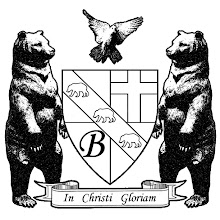
Whose coat of arms is more awesome, mine (left) or Pope Benedict XVI's?


For the record, I give the edge to mine.

(The Holy Father's is in color, but his only has one bear, whereas mine has five.)

Vote for your favorite in my poll on the right side of the screen.

UPDATE: The poll was an utter failure and has thus been prematurely discontinued.

Monday, October 1, 2007

A journey through John - 5:2-6

"Now there is in Jerusalem by the Sheep Gate a pool, in Hebrew called Bethzatha, which has five porticoes. In these lay a multitude of invalids, blind, lame, paralyzed. One man was there, who had been ill for thirty-eight years. When Jesus saw him and knew that he had been lying there a long time, he said to him, 'Do you want to be healed?'"

Jesus' question to the sick man seems, at first glance, completely ridiculous. This guy's been lying around with a bunch of invalids for thirty-eight years, and Jesus has to ask him if he wants to be healed? Come on.

If we understand this man's sickness as symbolic of the spiritual sickness of sin that afflicts us all, however, Jesus' question isn't quite so surprising. We know we're sinners, we know we're sick, but it's a comfortable sickness, and if we're honest with ourselves, we don't always want to be healed.

Jesus is always there, offering us His healing grace, but we have to want to be healed, we have to accept His grace. And when we do, He will heal us, just as he healed the sick man at the pool.